
PLB duct and DWC pipe get confused constantly, and the confusion is understandable — both are black HDPE, both go in a trench, both protect cable. But they are engineered around two different problems, and specifying the wrong one either wastes money or makes the installation harder than it needed to be.
The one-line answer: if optical fibre is being blown in, use PLB duct. If power or telecom cable is being pulled in and crush loading is the concern, use DWC.
Construction: The Physical Difference
Cut both pipes and the difference is immediately visible.
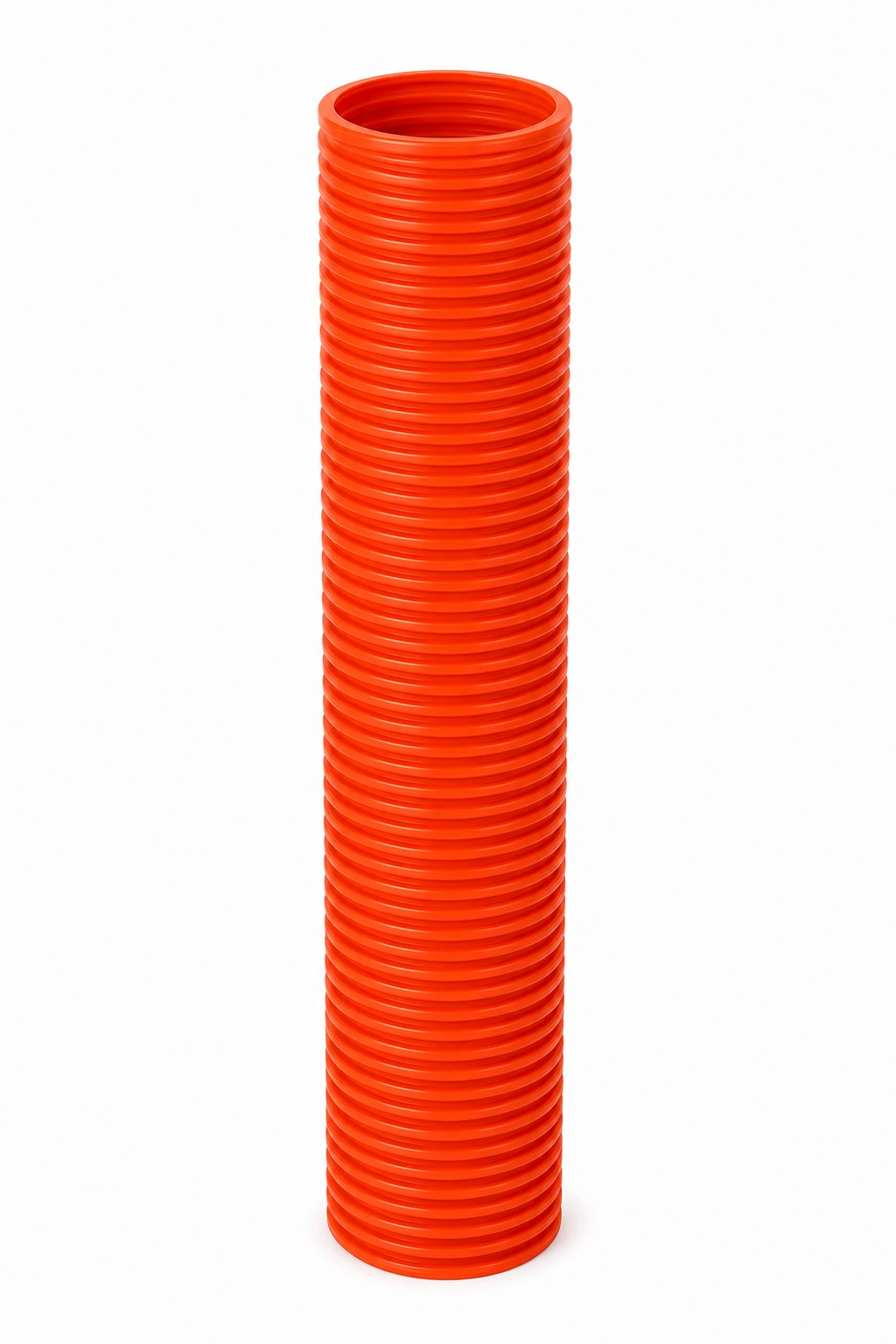
- DWC — two walls. The outer wall is corrugated into ribs, which is what gives high ring stiffness without using much material. The inner wall is smooth so cable does not snag. Air gaps sit between the ribs.
- PLB — two layers, not two walls. A solid virgin HDPE outer sheath is co-extruded with a thin inner silicore layer carrying silicone lubricant. The pipe is smooth-walled inside and out.
Side-by-Side Comparison
| Criterion | PLB Duct | DWC Pipe |
|---|---|---|
| Wall construction | Solid dual-layer (co-extruded) | Double wall, corrugated outer |
| Inner bore | Silicone lubricated (silicore) | Smooth, unlubricated |
| Coefficient of friction | ≤ 0.06 | Not rated for blowing |
| Rated by | Crush resistance (kgf) | Ring stiffness (SN 8 / 450N) |
| Standard | TEC GR; PE material IS 7328:2020 | IS 16025 Part 24 |
| Sizing convention | OD/ID pair (40/33mm) | Outer diameter (40–120mm) |
| Install method | Cable blown with compressed air | Cable pulled / winched |
| Continuous run | 1,000m+ | Limited by pulling tension |
| Supplied as | 200m / 500m / 1000m coils | 6m lengths or 50m coils |
| Jointing | Push-fit air-tight couplers | Snap-fit integral couplers |
| Best for | Optical fibre, FTTH, backhaul | Power cable, LT/HT, street lighting |
How to Choose
Choose PLB duct when
- The cable is optical fibre and will be blown in
- The route is long and you want to minimise access pits
- You expect to re-cable or upgrade fibre later in the duct's life
- The project is BharatNet, 5G backhaul, FTTH, or a highway OFC corridor
Choose DWC when
- The cable is power (LT/HT), street lighting, or a pulled telecom cable
- Crush loading is the governing design concern — heavy traffic, deep burial
- You need maximum ring stiffness for the material cost
- The specification calls out IS 16025 Part 24
Use both together when
On major routes it is common to lay a large DWC pipe as the outer protective casing and run several smaller PLB ducts inside it. The DWC takes the crush load from traffic and soil; the PLB ducts inside give you blowable, individually identifiable paths for each operator or each future fibre run. This is the standard arrangement on highway and smart city corridors, and it is worth designing in early — retrofitting spare capacity into an existing trench costs many times what it costs to lay it the first time.
The Cost Question
Comparing the per-metre price of PLB against DWC is the wrong comparison, because they are rarely competing for the same job. Where they genuinely do compete — a fibre route where someone is considering pulling instead of blowing — the number that decides it is the count of access pits. Excavation, traffic management, permits and reinstatement dwarf the duct cost. Cutting pits from one every 300m to one every kilometre is where the money is.
The Verdict
These are complementary products, not competitors. Fibre that gets blown wants PLB. Power cable that gets pulled wants DWC. Long routes with future capacity in mind want DWC casing with PLB ducts inside. TARKO manufactures both at MIDC Hingna, Nagpur — DWC cable duct from 40mm to 120mm to IS 16025 Part 24, and HDPE PLB duct from 25/20mm to 63/51mm.
Frequently Asked Questions
What is the difference between PLB duct and DWC pipe?
PLB duct is a smooth-wall, dual-layer HDPE pipe with a permanently lubricated bore, designed so optical fibre can be blown through it over long distances. DWC pipe is a double wall corrugated HDPE pipe — corrugated outside for crush strength, smooth inside — designed to protect power and telecom cables that are pulled into place. Different construction, different standards, different jobs.
Can I use DWC pipe for optical fibre?
You can run fibre inside DWC pipe, but you generally cannot blow it efficiently — DWC has no lubricated bore, so friction is far higher and blowing distance drops sharply. Common practice is to use DWC as an outer protective casing and run smaller PLB ducts inside it, which gives crush protection and blowability together.
Which is stronger, PLB or DWC?
DWC, by design. Its corrugated profile gives high ring stiffness (SN 8 / 450N) for the amount of material used, which is why it survives heavy soil loads and traffic. PLB duct is a solid-wall pipe rated by crush resistance in kgf (250 to 800 kgf depending on size) — adequate for normal burial, but DWC is the choice where crush loading is the governing concern.
Which standard applies to each?
DWC cable duct in India is specified by IS 16025 Part 24 and rated by ring stiffness class. PLB duct is specified for the category by the TEC Generic Requirement, with the PE raw material covered by IS 7328:2020 and railway work referencing RDSO/SPN/TC/45/2006.
Is PLB duct more expensive than DWC?
Per metre the two are broadly comparable, and the answer varies by size. The more useful comparison is installed cost: PLB reduces the number of access pits on a fibre route, and pits cost far more than duct. For a pulled power cable, DWC delivers the crush protection you actually need without paying for a lubricated bore you will never use.
Tools & Related Resources
Need Help Choosing the Right Pipe?
Our team at TARKO will help you select the correct size, SDR and pressure rating for your project.