
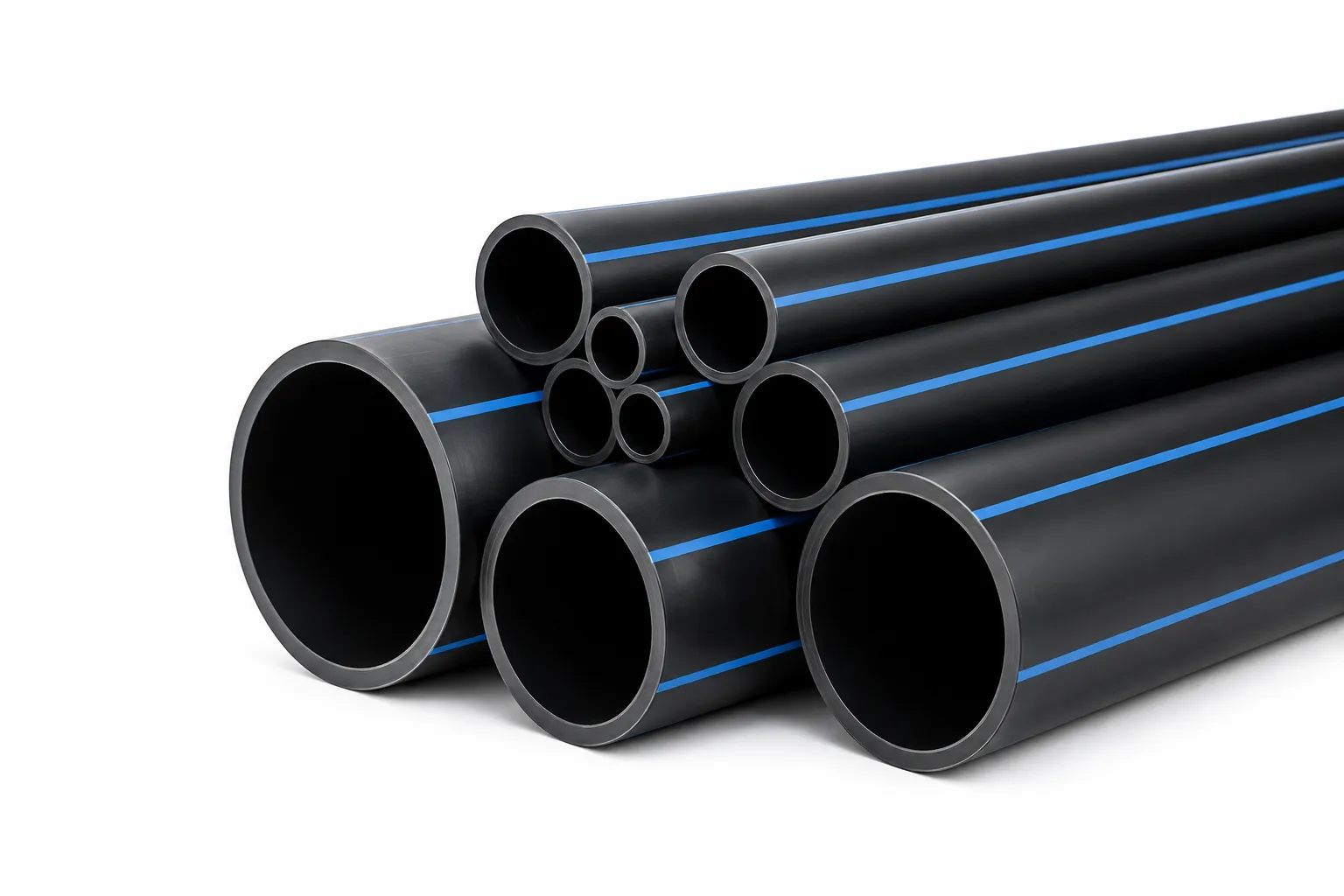
HDPE stands for High-Density Polyethylene — a thermoplastic made by polymerising ethylene gas into long, tightly packed polymer chains. Because those chains have very little branching, the material reaches a density of 0.941 g/cm³ or more, which is where the 'high-density' name comes from and which gives HDPE its strength, stiffness and chemical resistance. In pipe form, HDPE carries water, gas, slurry and cables underground for 50 years or more without rusting, scaling, corroding or leaking at the joints.
If you have been told to buy 'HDPE pipe' for a farm, borewell, housing project or government water scheme and you want to understand what you are actually buying — what the material is, what PE100 and SDR mean, which standard applies in India, and how the pipe gets joined — this guide covers all of it in order.
What Does HDPE Stand For?
HDPE = High-Density Polyethylene. Polyethylene is the world's most-used plastic, produced by linking ethylene (C₂H₄) molecules into chains of repeating −CH₂−CH₂− units. Ethylene itself comes from cracking natural gas or petroleum feedstock. What separates the polyethylene family into grades is not chemistry but architecture: how much the chains branch off sideways.
Straight chains with almost no branches can lie close together and crystallise. That tight packing raises the density, and with it the tensile strength, stiffness, hardness and resistance to chemicals and permeation. That is HDPE. Heavily branched chains cannot pack — they give a soft, floppy, low-density material (LDPE) that is excellent for carry bags and useless for pressure pipe.
| Type | Density (g/cm³) | Chain structure | Typical use |
|---|---|---|---|
| LDPE | 0.910 – 0.925 | Highly branched | Films, packaging, low-pressure tubing |
| LLDPE | 0.915 – 0.925 | Linear with short branches | Stretch film, drip laterals |
| MDPE | 0.926 – 0.940 | Moderately branched | Gas distribution pipe, fittings |
| HDPE | 0.941 and above | Linear, minimal branching | Pressure pipe, water mains, ducts, tanks |
Quick answer: HDPE is polyethylene with a density of 0.941 g/cm³ or higher. The tighter the chains pack, the stronger the pipe — which is why HDPE, not LDPE or MDPE, is what water and irrigation mains are made from.
Key Properties of HDPE
These are the numbers that matter when you are specifying or verifying HDPE pipe. Values are typical for pipe-grade PE100 resin; the exact figures for any batch come from the manufacturer's test certificate.
| Property | Typical value | Why it matters |
|---|---|---|
| Density | 0.950 – 0.960 g/cm³ (compounded) | Confirms the material is HDPE, not MDPE or reprocessed blend |
| Melt Flow Rate (MFR) | 0.2 – 0.7 g/10 min (5 kg, 190°C) | Controls extrusion behaviour and weldability; too high means low molecular weight |
| Tensile strength at yield | 22 – 31 MPa | Resistance to being pulled apart under internal pressure |
| Elongation at break | ≥ 350% | How far the pipe stretches before failing — the source of its toughness |
| Minimum Required Strength (MRS) | 10.0 MPa for PE100 | The 50-year hydrostatic strength that sets the pressure rating |
| Carbon black content | 2.0 – 2.5% | UV protection; outside this range the pipe either degrades or loses strength |
| Working temperature | −40°C to 60°C | Pressure must be de-rated above 20°C |
| Coefficient of thermal expansion | ≈ 0.2 mm/m/°C | Long above-ground runs need expansion allowance |
| Water absorption | < 0.01% | Dimensionally stable when buried and permanently wet |
| Resin identification code | 2 (HDPE) | Fully recyclable |
PE63, PE80 and PE100 — HDPE Pipe Grades Explained
HDPE pipe material is classified by Minimum Required Strength (MRS): the hoop stress in MPa that the material can withstand continuously for 50 years at 20°C, established by long-term hydrostatic testing and statistical extrapolation to ISO 9080. The classification number is simply MRS × 10.
- PE63 — MRS 6.3 MPa. Older, first-generation material. Still permitted by IS 4984 but rarely specified for new work.
- PE80 — MRS 8.0 MPa. Second generation. Common in gas distribution and smaller-diameter water lines.
- PE100 — MRS 10.0 MPa. Bimodal third-generation resin. The current default for water supply, irrigation and infrastructure.
The practical consequence: for the same outer diameter and the same pressure rating, a stronger grade needs less wall. A PE100 pipe therefore has a thinner wall, a bigger bore and better flow than a PE63 pipe of the same OD and PN — and it weighs less, so it costs less to transport and handle. This is why 'PE100' on the pipe marking is worth insisting on.
Minimum Required Strength (MRS) by PE Grade
Higher MRS = stronger pipe material. PE 100 handles the most pressure.
How HDPE Pipe Is Manufactured
HDPE pipe is made by continuous extrusion. The process is worth understanding because most quality problems trace back to a specific stage of it.
- 1Raw material: virgin PE100 granules are blended with a carbon black masterbatch to 2–2.5% and dried. Any recycled or reprocessed material entering here disqualifies the pipe for potable water and pressure service.
- 2Extrusion: the blend is melted at roughly 190–230°C in a single-screw extruder and forced through an annular die that forms the tube.
- 3Vacuum sizing and cooling: the hot tube passes through a vacuum calibration tank that fixes the outer diameter, then through spray-cooling baths that bring it to ambient temperature.
- 4Wall thickness control: ultrasonic gauges measure wall thickness continuously and feed back to the line speed and die, holding thickness within tolerance around the full circumference.
- 5Marking and haul-off: the pipe is printed with manufacturer, standard, size, grade, pressure class, batch and date, then pulled by a caterpillar haul-off.
- 6Coiling or cutting: sizes up to about 110mm OD are coiled in 50m/100m/200m lengths; larger sizes are cut into straight 6m or 12m lengths.
- 7Testing: samples go for hydrostatic pressure testing, carbon black content and dispersion, MFR, density, reversion and elongation as required by the standard, before the batch is released.
Why HDPE Pipes Are Black
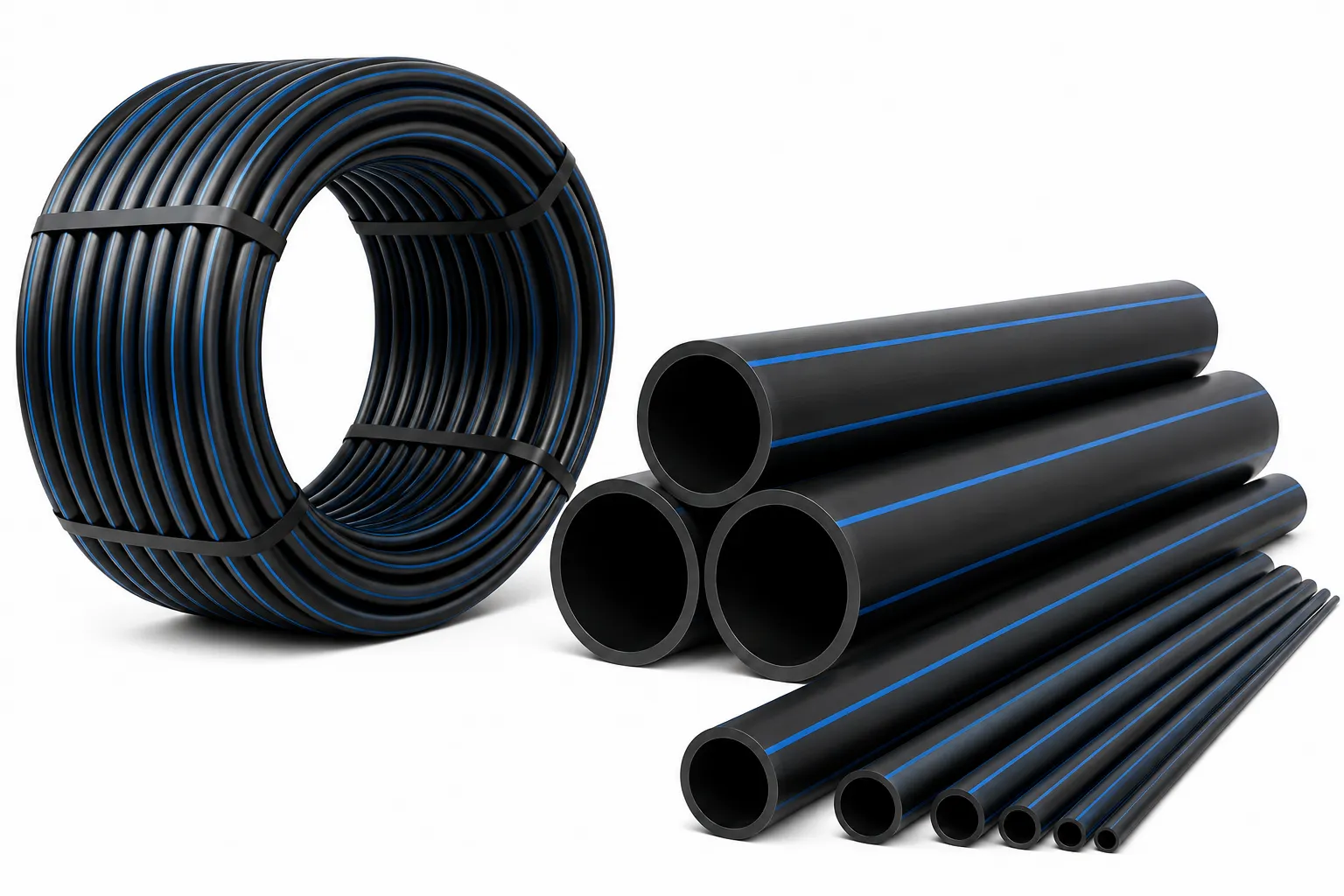
Ultraviolet light breaks polymer chains. Left unprotected, polyethylene exposed to sunlight loses elongation and impact strength, then cracks — often within two or three summers in Indian conditions. Compounding 2–2.5% finely dispersed carbon black into the material absorbs UV before it reaches the polymer, and gives HDPE pipe an effectively unlimited outdoor storage and service life.
Both the quantity and the dispersion matter. Below 2% the protection is incomplete; above about 2.5% the carbon particles start acting as stress concentrators and reduce strength. Poorly dispersed carbon leaves unprotected streaks that fail first. Both are tested under IS 4984. The blue stripe you see co-extruded along the pipe is a service identifier — blue for potable water — and is not related to UV protection.
Understanding HDPE Pipe Sizing: OD, SDR and PN
Three numbers describe every HDPE pipe, and they are related. Get these right and the rest of specification follows.
- OD (outer diameter) — HDPE pipe is always sized by outside diameter, in millimetres. A '110mm pipe' measures 110mm across the outside, not the bore. Standard sizes run 20, 25, 32, 40, 50, 63, 75, 90, 110, 125, 140, 160, 180, 200, 225, 250, 280, 315, 355, 400, 450, 500, 560, 630mm and larger.
- SDR (Standard Dimension Ratio) — outer diameter ÷ wall thickness. SDR 11 means the wall is one-eleventh of the OD. Lower SDR = thicker wall = higher pressure rating.
- PN (Pressure Nominal) — the working pressure in bar at 20°C. PN 6 means 6 bar (roughly 60 m head). PN classes run PN 2.5, 4, 6, 8, 10, 12.5 and 16.
The relationship: PN depends on both the material grade and the SDR. SDR 11 in PE100 gives PN 16; the same SDR 11 in PE80 gives only PN 12.5. Never specify SDR without also specifying the PE grade.
Relative Wall Thickness at a Glance
Each ring represents the pipe wall relative to the outer diameter. Thicker ring = more material = higher pressure.
HDPE Pressure Classes (PN Ratings)
PN = Nominal Pressure in bar. Green = low pressure (gravity/drip), Red = high pressure (borewell/fire).
Indian Standards for HDPE Pipe
In India, HDPE pipe is governed by Bureau of Indian Standards specifications. The relevant standard depends on the application, and the ISI Mark on the pipe is what certifies conformity.
| Standard | Scope | Sizes covered |
|---|---|---|
| IS 4984:2016 | HDPE pipes for potable water supply | DN 16 – 2500mm, PE63/PE80/PE100 |
| IS 14333:2016 | HDPE pipes for sewerage and drainage | DN 63 – 1000mm |
| IS 14151 (Parts 1 & 2) | HDPE sprinkler irrigation pipes and fittings | Up to 140mm |
| IS 14885:2001 | PE pipes for water supply — quality control | Referenced with IS 4984 |
| ISO 4427 | International equivalent for PE water pipe | Used for export and ISO-specified tenders |
| IS 7328 | PE material specification for moulding and extrusion | Raw material grade |
IS 4984:2016 specifies far more than dimensions. It fixes the permitted material grades, wall thickness tolerances, the mandatory marking on the pipe, and the test regime: hydrostatic pressure at 80°C for 165 hours, carbon black content and dispersion, melt flow rate, density, reversion (longitudinal shrinkage) and elongation at break. A pipe that passes all of it may carry the ISI Mark with the licence number printed alongside.
Verify before you buy: every ISI-marked pipe carries a BIS licence number in its printed marking. You can check that licence at bis.gov.in against the manufacturer's name and the standard it claims. An unverifiable licence number is the single most common sign of counterfeit pipe.
How HDPE Pipes Are Joined
This is HDPE's defining advantage. Two heat-fused HDPE pipes become a single continuous piece of material — the joint is not a seal that can loosen, it is a weld that is as strong as the pipe itself. There is nothing for roots to enter, nothing to corrode, and nothing to leak.
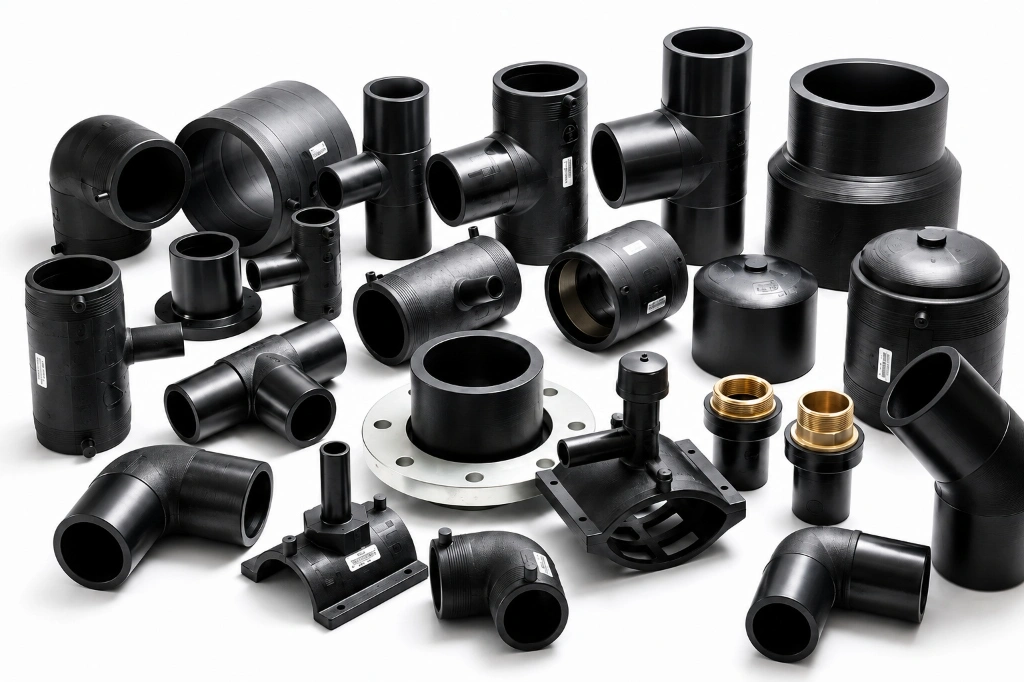
- Butt fusion — pipe ends are faced flat, heated against a plate at ~210°C, then pressed together and held under pressure while they cool. Used for 63mm and above. Strongest and most economical method for straight runs.
- Electrofusion — a moulded coupler with an embedded heating coil is slipped over both ends and energised; the coil melts the interface and welds it. Ideal in trenches and tight spaces where a butt fusion machine will not fit.
- Compression fittings — mechanical fittings with a grip ring and O-ring, tightened by hand or spanner. Fast, reusable, no power needed; used up to about 110mm for farm and service lines.
- Flanged joints — a stub end fused to the pipe plus a backing ring, bolted to valves, pumps or other materials. The standard way to connect HDPE to anything that is not HDPE, and the way to build a line that can be dismantled.
- Threaded / MTA-FTA adapters — male and female threaded transition fittings for connecting to GI, taps, sprinklers and pumps on small sizes.
Jointing Methods at a Glance
Rate out of 5 for each factor. Pick the method that matches your project priorities.
Joint Strength
Speed
Economy
Portability
Joint Strength
Speed
Economy
Portability
Joint Strength
Speed
Economy
Portability
Joint Strength
Speed
Economy
Portability
Joint Strength
Speed
Economy
Portability
Where HDPE Is Used
HDPE pipe shows up wherever a line has to be buried, pressurised, moved, or left outdoors — and especially wherever leaks are expensive.
Agriculture and irrigation
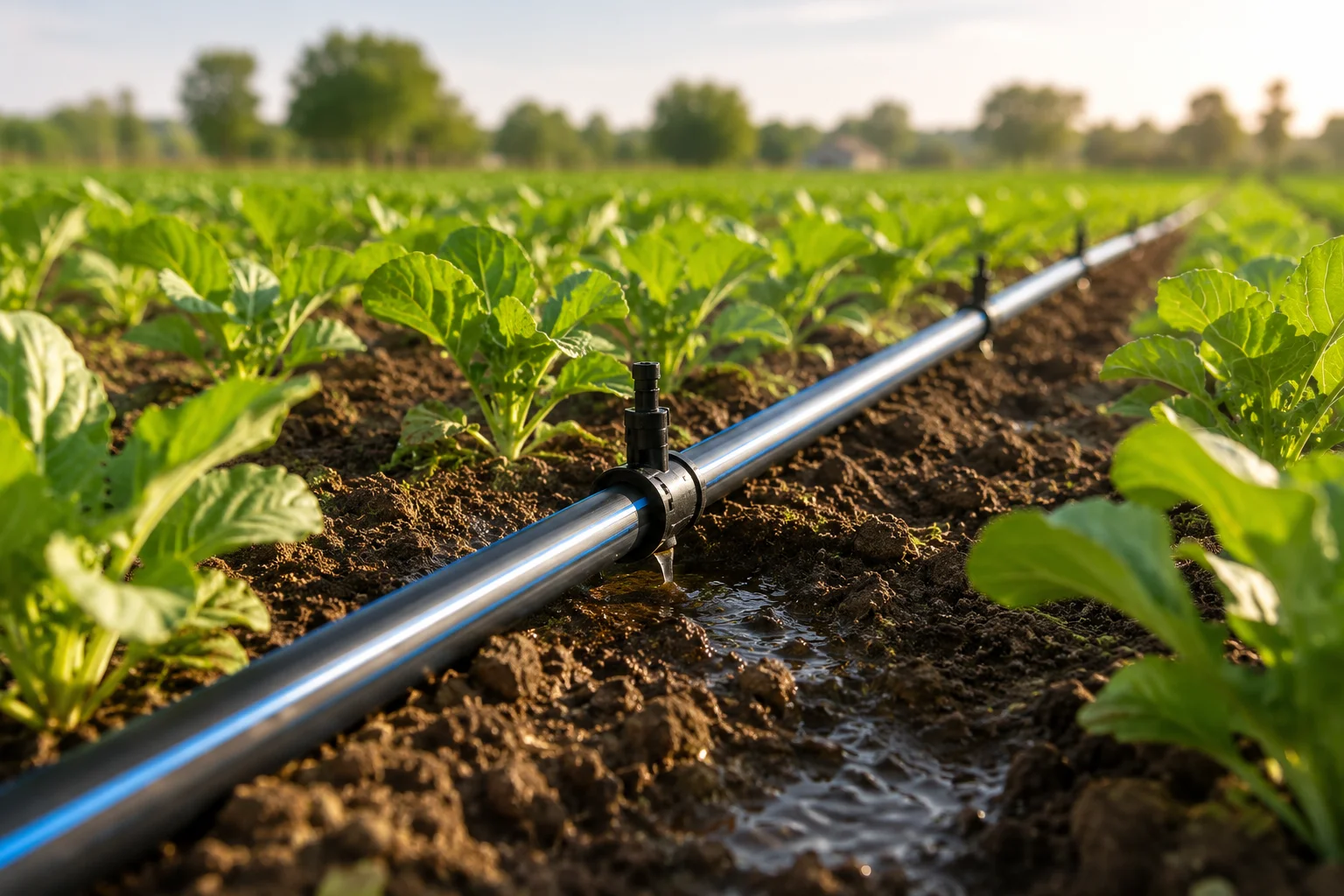
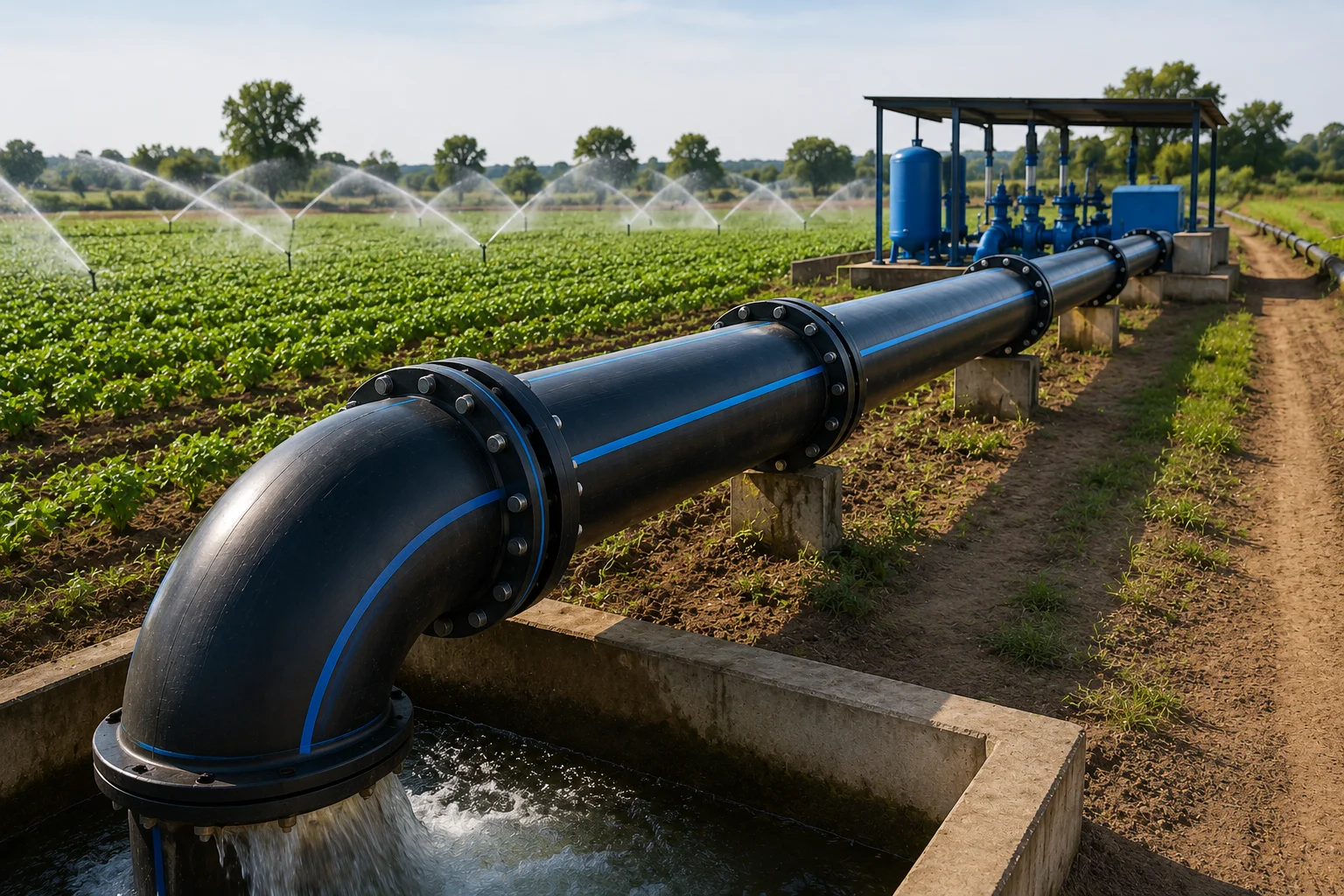
Main and sub-main lines for drip and sprinkler systems, canal-to-field conveyance, and borewell delivery lines. Coiled HDPE can be laid across a field in a single unbroken run with no joints to leak, and it survives being ploughed over and moved between seasons. Sprinkler-specific pipe to IS 14151 uses quick-coupling fittings so the line can be dismantled and shifted.
Drinking water supply
Village and municipal distribution networks, house service connections, and the trunk mains behind them. HDPE is the specified material across most Jal Jeevan Mission and AMRUT work: it does not corrode, does not scale, does not leach, and its fused joints keep non-revenue water losses low over decades.
Infrastructure and industry
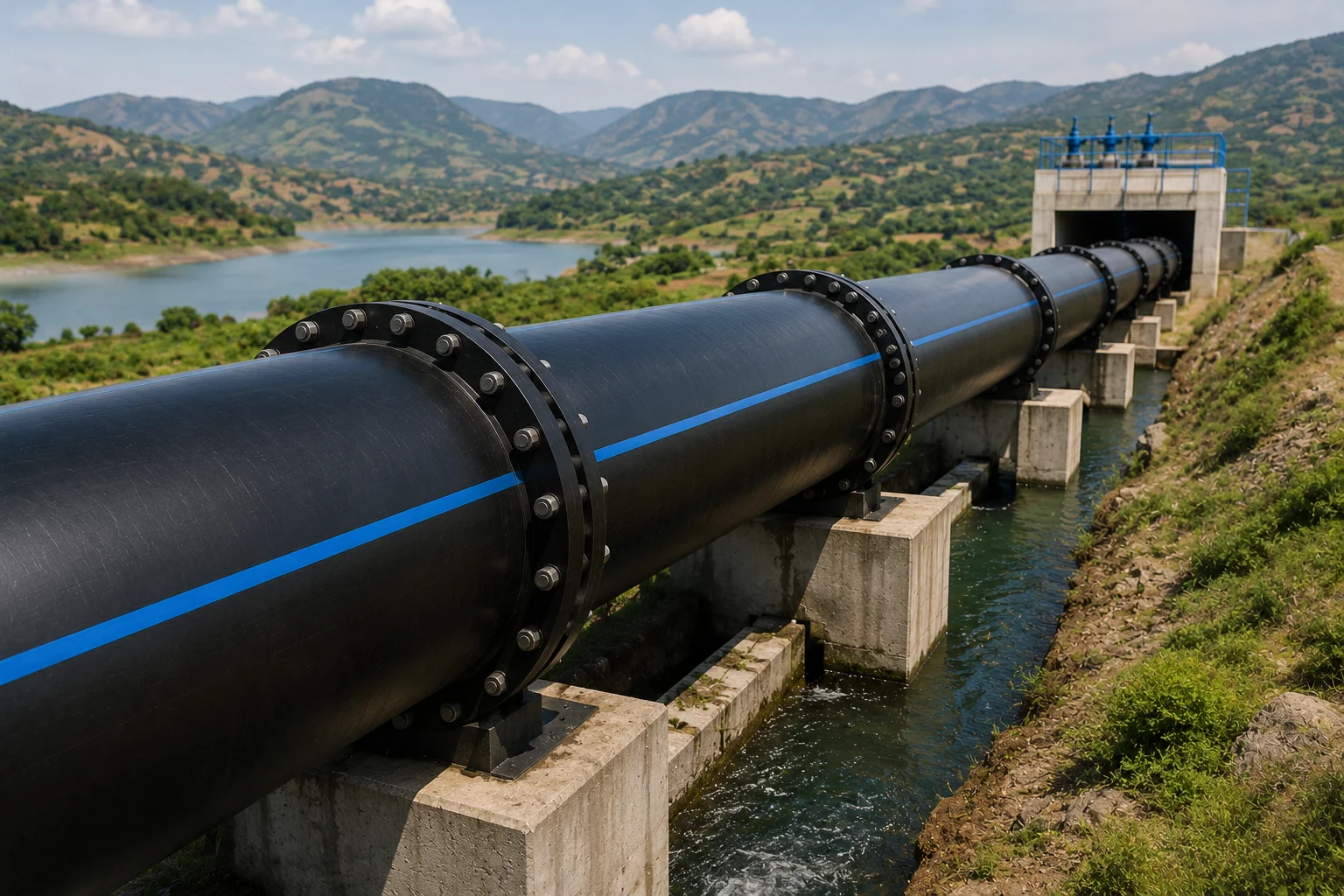
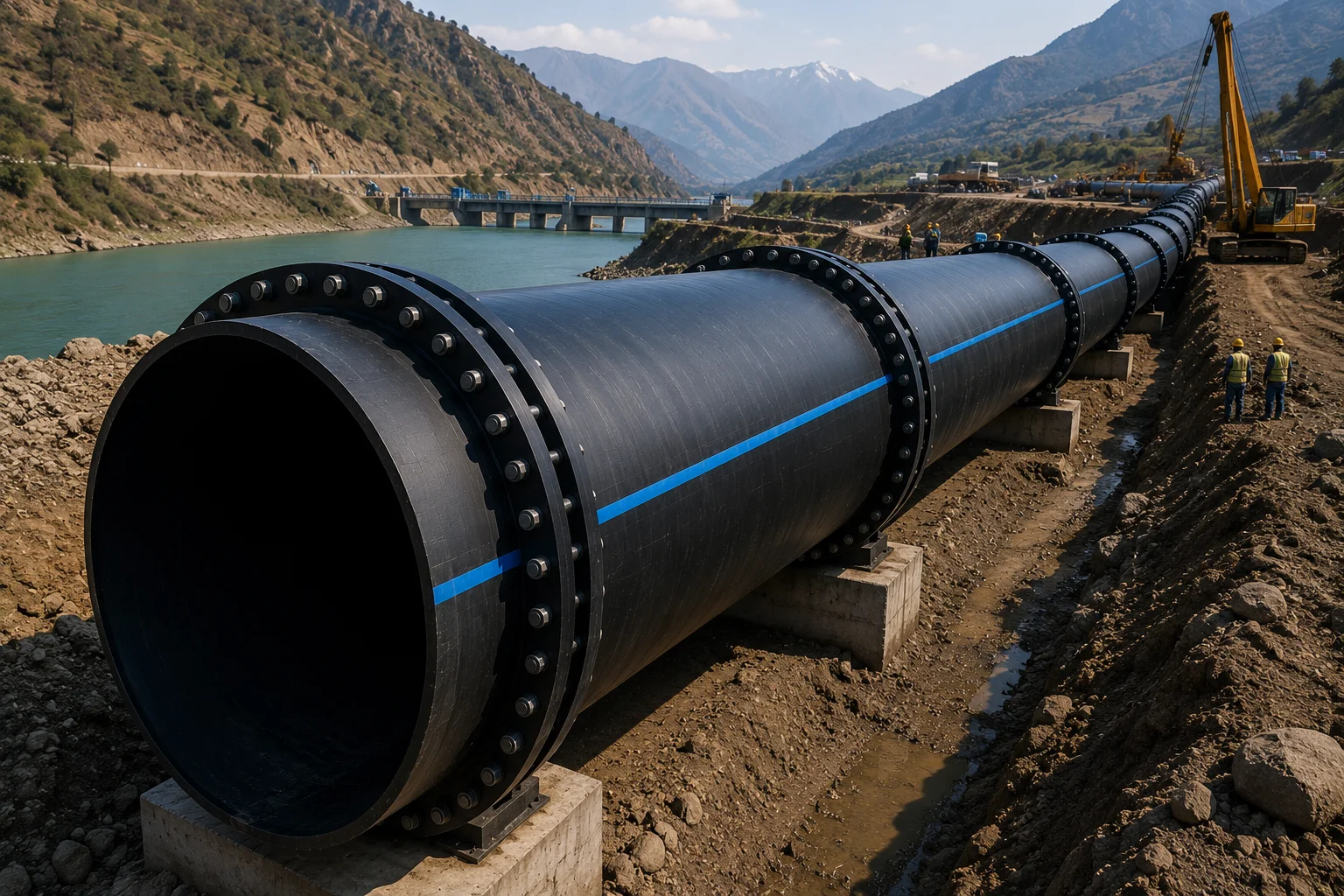
Raw water transmission mains, treatment plant interconnections, effluent and slurry lines, mine dewatering, cooling water, and desalination outfalls. Large-diameter HDPE is often chosen over ductile iron for corrosive ground, saline water, and river or sea crossings — a fused HDPE string can be floated into position and sunk.
Gas, cables and drainage
PE is the standard material for low-pressure gas distribution worldwide (usually MDPE or PE100 in yellow or orange). Non-pressure HDPE to IS 14333 handles sewerage and stormwater drainage. For cables, HDPE splits into two distinct duct types that are often confused:
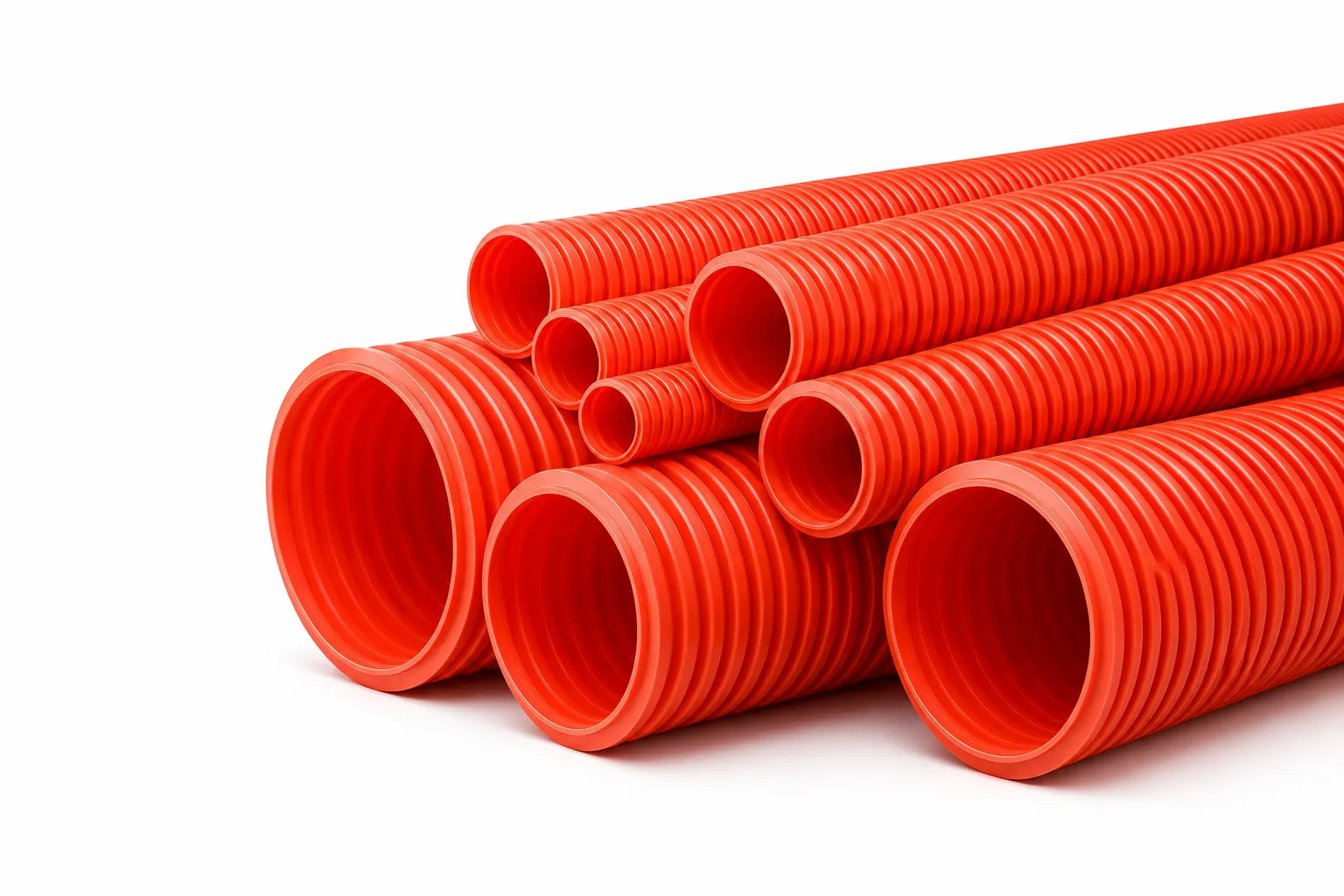
- DWC (Double Wall Corrugated) duct — corrugated outer wall for crush strength, smooth inner bore. Protects power, telecom and OFC cables that are pulled into place. Specified by IS 16025 Part 24 and rated by ring stiffness (SN 8 / 450N).
- HDPE PLB duct pipe (Permanently Lubricated Bore) — smooth-wall, dual-layer pipe with silicone lubricant co-extruded into the inner bore. The resulting coefficient of friction of 0.06 or lower lets optical fibre be blown in with compressed air over 1,000+ metres instead of pulled in 200–400m sections. Sized by OD/ID pair (25/20mm up to 63/51mm) and specified for the category by the TEC Generic Requirement.
Rule of thumb: if the cable is pulled, use DWC. If optical fibre is blown, use PLB duct — the lubricated bore is the whole point, and ordinary HDPE conduit (COF 0.15–0.25) cannot achieve the same blowing distance.
HDPE vs PVC vs GI vs Ductile Iron
The honest comparison, on the criteria that actually decide a project.
| Criterion | HDPE | PVC / uPVC | GI (galvanised iron) | Ductile iron |
|---|---|---|---|---|
| Corrosion / rust | None | None | Rusts and scales | Needs lining and coating |
| Flexibility | High — coils, absorbs ground movement | Brittle, cracks on impact | Rigid | Rigid |
| Joints | Heat-fused, leak-free | Solvent-cemented or rubber ring | Threaded, leak-prone | Push-on gasket |
| Weight | Light | Light | Heavy | Very heavy |
| Service life | 50+ years | 25 – 40 years | 10 – 20 years | 50+ years |
| UV resistance | Excellent (carbon black) | Poor unless stabilised | Good | Good |
| Pressure range | Up to PN 16 and beyond | Up to ~PN 10 typical | High | Very high |
| Material cost per metre | Moderate | Lowest | High | Highest |
| Installed cost | Low — fewer joints, fast fusion | Low | High — labour intensive | High |
| Best suited to | Buried, pressurised, outdoor, irrigation | Indoor plumbing, gravity drainage | Short exposed runs | Large urban trunk mains |
Advantages and Limitations of HDPE
HDPE is not the right answer everywhere, and knowing where it stops being the right answer is part of specifying it well.
Advantages
- Fully leak-free fused joints — the biggest single source of water loss in a network is eliminated
- Immune to corrosion, rust, scaling, tuberculation and most soil chemicals
- Flexible enough to absorb ground settlement, seismic movement and traffic loading
- Roughly one-eighth the weight of steel — cheaper to freight and can be laid without heavy plant
- Very smooth bore (Hazen-Williams C ≈ 150) that does not degrade, so pumping cost stays low for life
- Excellent impact resistance, including in cold weather where PVC becomes brittle
- Non-toxic and approved for potable water
- 50+ year design life and full recyclability at end of life
Limitations
- Temperature-limited: rated at 20°C, de-rated above it, and unsuitable for pressure service beyond about 60°C
- Higher thermal expansion than metal — long above-ground runs need expansion loops or anchoring
- Butt fusion and electrofusion need trained operators and powered equipment on site
- Not suitable for petrol, diesel or aromatic hydrocarbons, which swell and permeate the polymer
- Should not be laid through contaminated ground without a barrier pipe — some solvents can permeate the wall and taint potable water
- Larger outer diameter than a metal pipe of equal bore, so trench and sleeve sizes are bigger
- Lower ring stiffness than concrete or DI — buried non-pressure lines need correct bedding and backfill
How to Check You Are Buying Genuine HDPE Pipe
The market carries a lot of pipe made from reprocessed material and marked as something it is not. Five checks catch most of it.
- 1Read the printed marking. It must show manufacturer, standard (e.g. IS 4984:2016), size, PE grade, pressure class, batch number, date and the ISI Mark with a BIS licence number.
- 2Verify the licence number at bis.gov.in against the manufacturer's name. This takes two minutes and is the single most effective check.
- 3Ask for the batch test certificate — hydrostatic test, carbon black content and dispersion, MFR, density and elongation.
- 4Weigh a known length. Reprocessed or under-thick pipe is measurably lighter than the standard's dimensions imply. Compare against the wall thickness table for that OD and SDR.
- 5Look at the cut end. Genuine pipe has a uniform matt black wall of even thickness, with no grey streaks, voids, glossy patches or visible specks of contaminant.
Environmental Profile and Recycling
HDPE carries resin identification code 2 and is among the most readily recycled plastics. Production offcuts and end-of-life pipe are reground and reprocessed into cable ducts, drainage, geomembranes and moulded goods — though never back into potable-water or pressure pipe, where only virgin resin is permitted.
Over a full life cycle HDPE generally compares well with metal alternatives: it is lighter to transport, needs no coating or cathodic protection, requires very little maintenance, and its leak-free joints save treated water for fifty years. The counterweight is that it is a fossil-derived polymer, so its value depends on the line actually reaching its design life rather than being replaced early.
Quick Summary
- HDPE = High-Density Polyethylene — a thermoplastic of density ≥ 0.941 g/cm³ with linear, tightly packed polymer chains
- Pipe grades are classified by 50-year strength: PE63 (MRS 6.3), PE80 (MRS 8.0), PE100 (MRS 10.0). PE100 is the current standard
- Sized by outer diameter; SDR sets wall thickness; PE grade + SDR together set the PN pressure rating
- Governed in India by IS 4984:2016 for water, IS 14333 for sewerage and IS 14151 for sprinkler pipe — verify the ISI licence at bis.gov.in
- Black because of 2–2.5% carbon black, which blocks UV and prevents embrittlement
- Joined by butt fusion, electrofusion, compression fittings or flanges — fused joints are as strong as the pipe
- Used for irrigation, drinking water, gas, sewerage, cable ducting, and industrial and mining lines
- 50+ year design life, non-toxic, corrosion-proof and recyclable — but temperature-limited and not for hydrocarbons
TARKO manufactures BIS/ISI certified PE100 HDPE pipe to IS 4984:2016 from 20mm to 630mm, in all pressure classes from PN 2.5 to PN 16, at our plant at MIDC Hingna, Nagpur. If you know your flow and head but not your pipe, the pipe selector tool below will size it for you.
Frequently Asked Questions
What is the full form of HDPE?
HDPE stands for High-Density Polyethylene. It is a thermoplastic polymer made by polymerising ethylene gas, with a density of 0.941 g/cm³ or higher — which is what makes it 'high-density' as opposed to LDPE (low-density polyethylene) or MDPE (medium-density polyethylene).
Is HDPE pipe safe for drinking water?
Yes. HDPE is non-toxic, does not corrode, does not leach metals, and does not support bacterial growth on its smooth inner wall. In India, HDPE pipe for potable water must conform to IS 4984:2016 and carry the ISI Mark; those pipes are approved for drinking water supply under Jal Jeevan Mission and municipal schemes. Only use virgin PE100/PE80 pipe — recycled or 'reprocessed' material is not permitted for potable water.
Is HDPE better than PVC?
For buried, pressurised and outdoor lines — irrigation, borewells, water mains — HDPE is better: it is flexible instead of brittle, its heat-fused joints are leak-free rather than glued, it survives ground movement and impact, and it lasts 50+ years. PVC is cheaper per metre and is perfectly adequate for indoor plumbing and gravity drainage, where flexibility and fused joints add no value.
Why are HDPE pipes black?
Because 2–2.5% carbon black is compounded into the material. Carbon black absorbs ultraviolet radiation and stops sunlight from breaking the polymer chains, so the pipe does not become brittle when stored or run above ground. Uncoloured or lightly pigmented polyethylene exposed to Indian sunlight can crack within a few years; black HDPE does not.
How long does HDPE pipe last?
HDPE pipe is designed for a minimum 50-year service life at 20°C when operated at or below its rated pressure. The PE100 classification itself is derived from a 50-year extrapolated hydrostatic strength (MRS 10 MPa). Buried lines regularly exceed this — European PE mains from the 1960s are still in service.
What is the difference between HDPE, MDPE and LDPE?
The difference is density and chain branching. LDPE (0.910–0.925 g/cm³) is heavily branched, soft and used for films and low-pressure tubing. MDPE (0.926–0.940 g/cm³) sits in between and is common for gas distribution. HDPE (≥0.941 g/cm³) has minimal branching, so its chains pack tightly — giving the highest stiffness, tensile strength and pressure rating of the three.
What temperature can HDPE handle?
HDPE pipe is rated at 20°C. It stays serviceable from about −40°C up to roughly 60°C, but the allowable working pressure falls as temperature rises — at 40°C you should de-rate to about 75% of the nameplate PN, and beyond 60°C HDPE is not suitable for pressure service. HDPE does not become brittle in cold weather, which is why it is used in Himalayan and desert schemes alike.
What is PE100 and how is it different from PE63 and PE80?
PE63, PE80 and PE100 are material classifications based on Minimum Required Strength (MRS) — the 50-year hydrostatic strength in MPa (6.3, 8.0 and 10.0 MPa respectively). A higher MRS means a thinner wall carries the same pressure, so a PE100 pipe of the same outer diameter and pressure class has a larger bore and better flow than a PE63 one. PE100 is the current standard for water and irrigation.
What does SDR mean on an HDPE pipe?
SDR is the Standard Dimension Ratio — the outer diameter divided by the wall thickness. A lower SDR means a thicker wall and a higher pressure rating. SDR 11 is thicker and stronger than SDR 17. Together with the PE grade, SDR determines the PN (pressure nominal) rating of the pipe.
Can HDPE pipe be recycled?
Yes. HDPE is resin identification code 2 and is one of the most widely recycled plastics. Offcuts and end-of-life pipe can be reground and reprocessed into non-pressure products such as cable ducts, drainage and moulded goods. Recycled material must not be used in pipe intended for potable water or pressure service.
Tools & Related Resources
Confused by a term? Look it up
FREE TOOLGet a PN & SDR recommendation
TECHNICAL GUIDEPE63 vs PE80 vs PE100: Complete Material Grade Comparison
CHART & REFERENCEHDPE Pipe SDR Chart — Complete Reference for IS 4984:2016
CHART & REFERENCEHDPE Pipe PN Pressure Rating Chart — IS 4984:2016
INSTALLATIONHDPE Pipe Jointing Guide — Butt Fusion, Electrofusion & Mechanical
COMPARISONHDPE vs PVC Pipe — Which Is Better for Water & Irrigation?
TECHNICAL GUIDEHDPE Pipe Manufacturer in India
Need Help Choosing the Right Pipe?
Our team at TARKO will help you select the correct size, SDR and pressure rating for your project.