
PLB duct pipe is an HDPE conduit built for one job: getting optical fibre cable underground quickly and without damaging it. PLB stands for Permanently Lubricated Bore, and that phrase is the entire product description — the inner surface of the duct carries a silicone lubricant that was co-extruded into the polymer during manufacture, not sprayed on afterwards.
What Does PLB Stand For?
Permanently Lubricated Bore. The word that matters is 'permanently'. A lubricant sprayed into a duct washes out with groundwater, wears away during the first cable pull, and is gone entirely by the time anyone needs to re-cable years later. In a PLB duct the lubricant is locked into the polymer matrix of the inner layer, so it is still working decades after the duct is buried — including on the second or third cable that gets blown through it.
How the Silicore Layer Works
A PLB duct is a single pipe made of two layers bonded during a co-extrusion process:
- Outer sheath — virgin HDPE, typically 2.5 ± 0.5% carbon black in black compound for UV stability. This layer carries the crush and impact loads of burial.
- Inner silicore layer — virgin HDPE compounded with silicone lubricant, roughly 0.28mm to 0.42mm thick on a 40mm duct. This layer does nothing structural; it exists purely to lower friction.
The result is a coefficient of friction of 0.06 or lower against the cable jacket, versus roughly 0.15–0.25 for ordinary HDPE conduit. That single number is why PLB duct exists.
Why Friction Decides Your Installation Cost
Fibre can be installed two ways. It can be winched — a rope is pulled through first, then the cable is dragged behind it. Or it can be blown — compressed air carries the cable along the duct with the cable barely touching the wall. Blowing is faster, gentler on the fibre, and covers far more distance per setup, but it only works if the bore is slippery enough.
| PLB Duct | Plain HDPE Conduit | |
|---|---|---|
| Coefficient of friction | ≤ 0.06 | 0.15 – 0.25 |
| Install method | Blown with compressed air | Winched / pulled |
| Continuous run | 1,000m+ | 200 – 400m |
| Install speed | Up to 100 m/min | Considerably slower |
| Access pits needed | Few | Every 200–400m |
| Re-cabling years later | Bore still lubricated | Friction unchanged / worse |
The cost is not in the duct — it is in the ground. Every access pit means excavation, traffic management, reinstatement and a permit. Going from a pit every 300 metres to a pit every kilometre removes roughly two-thirds of them across a route. On a long highway or BharatNet run, that dwarfs the price difference between PLB and plain conduit.
PLB Duct Size Chart
PLB duct is designated by an OD/ID pair rather than by a single diameter — a '40/33' duct is 40mm on the outside and 33mm on the inside. Crush resistance figures below are the minimums commonly specified for each size.
| Size (OD/ID) | Wall Thickness | Crush Resistance | Typical Use |
|---|---|---|---|
| 25/20mm | 2.5 ± 0.2mm | 250 kgf | FTTH last-mile drops |
| 32/26mm | 3.0 ± 0.2mm | 250 kgf | Secondary distribution |
| 40/33mm | 3.5 ± 0.2mm | 450 kgf | Backbone — most common size |
| 50/42mm | 4.0 ± 0.2mm | 550 kgf | Larger-diameter cables |
| 63/51mm | 6.0 ± 0.5mm | 800 kgf | Trunk network routes |
Colours and Identification
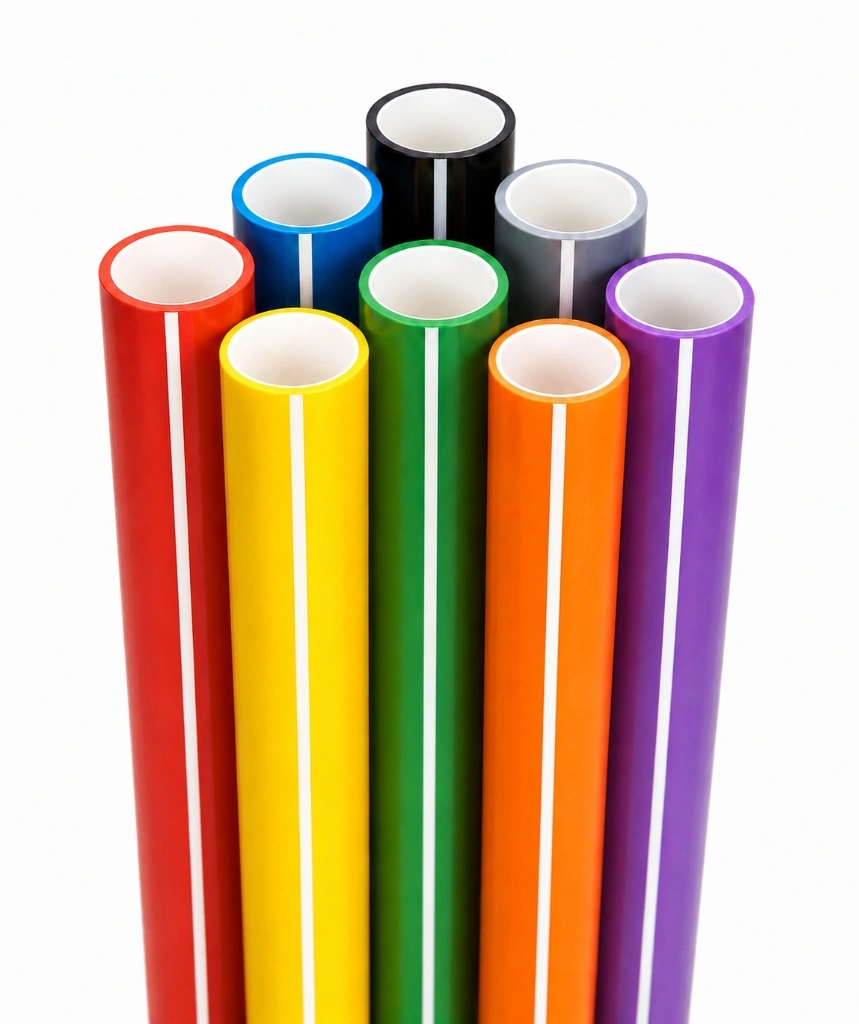
PLB duct is supplied in identification colours — commonly red, green, orange, blue, yellow, grey, brown and black — so that several operators or several networks can share one trench without confusion at every chamber. There is no single mandatory national colour code in India; the scheme is normally fixed by the project or the operator, and identification stripes along the length can be printed to requirement.
Jointing, Coils and Accessories
PLB duct must hold air pressure, because that is how the cable gets installed. This makes jointing different from water pipe, where a joint only has to hold water out.
- Push-fit couplers — join two duct lengths air-tight and water-tight without heat or tools
- End plugs — seal the duct before cable is installed, keeping silt and water out of the bore
- Cable sealing plugs — seal around the cable after installation
- Coils of 200m, 500m or 1,000m — longer coils mean fewer joints, which means fewer potential air leaks
Where PLB Duct Is Used in India
- BharatNet — gram panchayat fibre connectivity across rural India
- 5G backhaul and tower fiberisation
- NHAI and MoRTH highway optical fibre corridors
- Railway signalling and telecom networks (RDSO-referenced work)
- Smart city underground utility ducting
- FTTH and broadband rollout by private ISPs and cable operators
Quick Summary
- PLB = Permanently Lubricated Bore — silicone lubricant co-extruded into the inner wall, not coated on
- Coefficient of friction ≤ 0.06 versus 0.15–0.25 for plain HDPE conduit
- Lets fibre be blown at up to 100 m/min over 1,000m+ instead of pulled in 200–400m sections
- Dual-layer construction: virgin HDPE outer sheath + silicore inner layer
- Sizes 25/20mm to 63/51mm, designated as OD/ID; 40/33mm is the common backbone size
- Supplied in 200m / 500m / 1,000m coils with push-fit air-tight couplers
- Category specified by TEC Generic Requirement; PE raw material by IS 7328:2020
TARKO manufactures HDPE PLB duct pipe at MIDC Hingna, Nagpur, in all five standard sizes from 25/20mm to 63/51mm, from virgin polyethylene conforming to IS 7328:2020. If your project specifies a particular approval or test certification, tell us the requirement and we will confirm in writing what we can supply against it before you order.
Frequently Asked Questions
What is the full form of PLB duct?
PLB stands for Permanently Lubricated Bore. The name describes the defining feature: a silicone-based lubricant is co-extruded into the inner wall of the HDPE duct during manufacture, so the bore stays slippery permanently rather than being coated after the fact.
What is the coefficient of friction of PLB duct?
0.06 or lower against the cable jacket. Ordinary HDPE conduit sits around 0.15 to 0.25. That gap is what allows fibre to be blown in with compressed air at up to 100 m/min over continuous runs beyond 1,000 metres.
What sizes does PLB duct come in?
PLB duct is designated as an OD/ID pair. The standard sizes are 25/20mm, 32/26mm, 40/33mm, 50/42mm and 63/51mm. 40/33mm is the most common backbone size; 25/20mm is typical for FTTH last-mile drops.
Is PLB duct the same as HDPE duct?
PLB duct is a type of HDPE duct, but not all HDPE duct is PLB. Plain HDPE conduit is a single-layer extrusion with an untreated bore. PLB duct is a dual-layer co-extrusion with a silicore inner layer. Both are made of high-density polyethylene; only PLB is built for cable blowing.
What standard governs PLB duct in India?
The finished duct is specified for the category by the TEC (Telecommunication Engineering Centre) Generic Requirement; railway signalling work additionally references RDSO/SPN/TC/45/2006. The polyethylene raw material is covered by IS 7328:2020. If your tender requires a specific approval, confirm the certification requirement with your supplier in writing before ordering.
How long are PLB duct coils?
Standard coil lengths are 200m, 500m and 1,000m. Longer coils mean fewer joints across a route, which matters because every joint is a potential air leak during cable blowing and a potential water ingress point afterwards.
Tools & Related Resources
Need Help Choosing the Right Pipe?
Our team at TARKO will help you select the correct size, SDR and pressure rating for your project.