IS 4984:2016 — 'Polyethylene Pipes for Water Supply — Specification (Fifth Revision)' — is the governing technical standard for HDPE potable water piping across India. Administered by the Bureau of Indian Standards (BIS) under Scheme-I of the BIS (Conformity Assessment) Regulations 2018 (Document No. PM/ IS 4984/3/June 2022), it defines the chemical, mechanical, dimensional, and testing benchmarks required for pipes carrying potable water under pressure.
1. Raw Material Specifications (Clause 5)
Under Clause 5 of IS 4984:2016, the durability and service life of an HDPE pipe depend directly on virgin polymer integrity. The standard mandates three critical raw material controls:
- Polyethylene Resin (Clause 5.2): Must meet Table 2 (base density 940–960 kg/m³, MFR 0.15–1.1 g/10 min, OIT > 20 min) and IS 7328:2020. Up to 5% of the manufacturer's own rework material is permitted (Amendment 2, clause 5.5); no other rework or recycled material is allowed. Pre-compounded black material or natural resin with dedicated carbon black masterbatch must be used.
- Carbon Black (Clauses 5.3 and 8.3): finished pipe must contain 2.5 ± 0.5% carbon black by mass, well dispersed, to provide complete protection against UV degradation when laid above ground or stored outdoors.
- Anti-Oxidant Incorporation (Clause 5.4): Food-grade phenolic and phosphite antioxidants must be homogeneously compounded to resist thermal degradation during extrusion and ensure an Oxidation Induction Time (OIT) exceeding 20 minutes at 200°C.
2. Product Grouping (BIS Product Manual)
For certification and quality audit under the BIS Product Manual, polyethylene pipes are categorized into standardized material grades, pressure classes, and diameter groups:
| Parameter | Standard Classifications under IS 4984:2016 |
|---|---|
| Material Grades | PE 63 (MRS 6.3 MPa), PE 80 (MRS 8.0 MPa), PE 100 (MRS 10.0 MPa) |
| Standard Dimension Ratio (SDR) | SDR 41, SDR 33, SDR 26, SDR 21, SDR 17, SDR 13.6, SDR 11, SDR 9, SDR 7.4, SDR 6 |
| Pressure Ratings (PN) | PN 2, PN 2.5, PN 3.2, PN 4, PN 5, PN 6, PN 8, PN 10, PN 12.5, PN 16, PN 20 (bar) |
| Nominal Diameter (DN) | DN 16 mm up to DN 2,500 mm (TARKO manufactures 20mm to 630mm) |
Pressure Rating & Size Groups for BIS Scheme-I Auditing
The BIS Product Manual classifies pipes into three Pressure Groups and five Size Groups for rigorous third-party batch surveillance and testing:
| Material Grade | Pressure Group A | Pressure Group B | Pressure Group C | Size Groups Covered |
|---|---|---|---|---|
| PE 63 | PN 2, PN 2.5, PN 3.2, PN 4 | PN 5, PN 6, PN 8 | Not Applicable | Group-I (16–180mm), Group-II (200–500mm), Group-III (560–1000mm) |
| PE 80 | PN 2.5, PN 3.2, PN 4 | PN 5, PN 6, PN 8, PN 10 | PN 12.5, PN 16, PN 20 | Group-I (16–180mm), Group-II (200–500mm), Group-III (560–1000mm) |
| PE 100 | PN 3.2, PN 4 | PN 5, PN 6, PN 8, PN 10 | PN 12.5, PN 16, PN 20 | Group-I (16–180mm), Group-II (200–500mm), Group-III (560–1000mm) |
3. Working Pressure (PN) vs SDR Relationship
The working pressure rating (PN in bar) of an HDPE pipe is directly derived from the material's Minimum Required Strength (MRS) and its Standard Dimension Ratio (SDR = Outer Diameter ÷ Wall Thickness). With the overall service design coefficient C = 1.25 and the pressure reduction coefficient fT = 0.85 for water at 27 °C (Annex A), the relationship is:
PN (bar) = 20 × (MRS ÷ C) ÷ (SDR − 1) × fT. For PE100: 20 × (10.0 ÷ 1.25) ÷ (SDR − 1) × 0.85 = 136 ÷ (SDR − 1), taken down to the nearest PN in the series. Example: SDR 11 → 13.6 → PN 12.5.
| SDR Class | PE100 Working Pressure (PN) | PE80 Working Pressure (PN) | Typical Project Applications |
|---|---|---|---|
| SDR 41 | PN 3.2 (3.2 bar) | PN 2.5 (2.5 bar) | Low pressure gravity flow, drainage, flood irrigation |
| SDR 33 | PN 4 (4 bar) | PN 3.2 (3.2 bar) | Agricultural surface irrigation, open field discharge |
| SDR 26 | PN 5 (5 bar) | PN 4 (4 bar) | Farm water distribution, sprinkler mains, rural water lines |
| SDR 21 | PN 6 (6 bar) | PN 5 (5 bar) | Medium-head submersible pumps, rural gravity schemes |
| SDR 17 | PN 8 (8 bar) | PN 6 (6 bar) | Standard municipal distribution, Jal Jeevan Mission village mains |
| SDR 13.6 | PN 10 (10 bar) | PN 8 (8 bar) | High-pressure transmission mains, rolling terrain water supply |
| SDR 11 | PN 12.5 (12.5 bar) | PN 10 (10 bar) | Treated bulk water pipelines, pump discharge risers, industrial mains |
| SDR 9 | PN 16 (16 bar) | PN 12.5 (12.5 bar) | High-stress surge mains, deep borewell column piping, mining slurries |
4. Scheme of Inspection and Mandatory Testing (BIS Product Manual)
Under Annex C and Table 1 of the BIS Product Manual, every certified manufacturing unit must operate a fully equipped internal testing laboratory (Annex B). A 'Control Unit' is defined as up to 48 hours of continuous extrusion from a single machine using the same batch of raw material. Testing frequencies and pass criteria include:
| Clause & Requirement | Test Method | BIS Test Level & Frequency | Engineering Acceptance Criteria |
|---|---|---|---|
| 7.1–7.4 Dimensions & Visual | IS 4984 Clause 7 | 10 samples per 48h control unit | Smooth finish, free of voids/grooves; mean OD & ovality within Table 3, wall thickness within Table 4 |
| 8.1.1 Creep Rupture @ 80°C (48h) | IS 4984 Annex E | 1 sample per 48h control unit (100%) | No failure, rupture or weep under 5.7 MPa (PE100) / 4.9 MPa (PE80) hoop stress |
| 8.1.1 Creep Rupture @ 27°C (100h) | IS 4984 Annex E | 3 samples once in 3 months | No burst or leakage under 10.7 MPa (PE100) / 8.6 MPa (PE80) hoop stress |
| 8.1.1 Creep Rupture @ 80°C (165h) | IS 4984 Annex E | 3 samples once in 3 months | No failure under 5.4 MPa (PE100) / 4.5 MPa (PE80) hoop stress |
| 8.1.1 Creep Rupture @ 80°C (1000h) | IS 4984 Annex E | 3 samples once in 6 months | No failure under 5.0 MPa (PE100) / 4.0 MPa (PE80) hoop stress |
| 8.2 Longitudinal Reversion | IS 4984 Annex F | 1 sample per 48h control unit | Hot air oven at 110°C ± 2°C; length change must be ≤ 3% |
| 8.3 Carbon Black Content & Dispersion | IS 2530 | Composite of 3 pipes per control unit | Content 2.5 ± 0.5% by mass (2.0–3.0%); dispersion as per 5.4.6 of IS 7328 (Amendment 2) |
| 8.4 Melt Flow Rate (MFR) | IS 2530 | Composite of 3 pipes per control unit | Tested under 5 kgf load @ 190°C; must not deviate from the resin MFR by more than 30% |
| 8.5 Oxidation Induction Time (OIT) | IS 4984 Annex B | 1 sample per control unit | Thermal analysis in pure oxygen at 200°C; OIT must exceed 20 minutes |
| 8.6 Overall Migration Test | IS 9845 / IS 10146 | 3 samples once in 3 months | Safe for potable drinking water; zero toxic or plasticizer migration into water |
5. Standard Marking (Clause 10)
Pipes conforming to IS 4984:2016 must be continuously and indelibly marked along their length. Clause 10 (as revised by Amendment 2) requires, every 1 m, the manufacturer's name or trade mark, the pipe designation per clause 6.1 (grade, PN, nominal OD, SDR) and the lot/batch number with date of manufacture; the Standard Mark may be added under a BIS licence. A typical print line:
TARKO IS 4984:2016 [ISI Mark] CM/L-XXXXXXXXXX • PE100 • PN 10 • DN 110 • SDR 11 • BATCH-XXXX • B2-2026
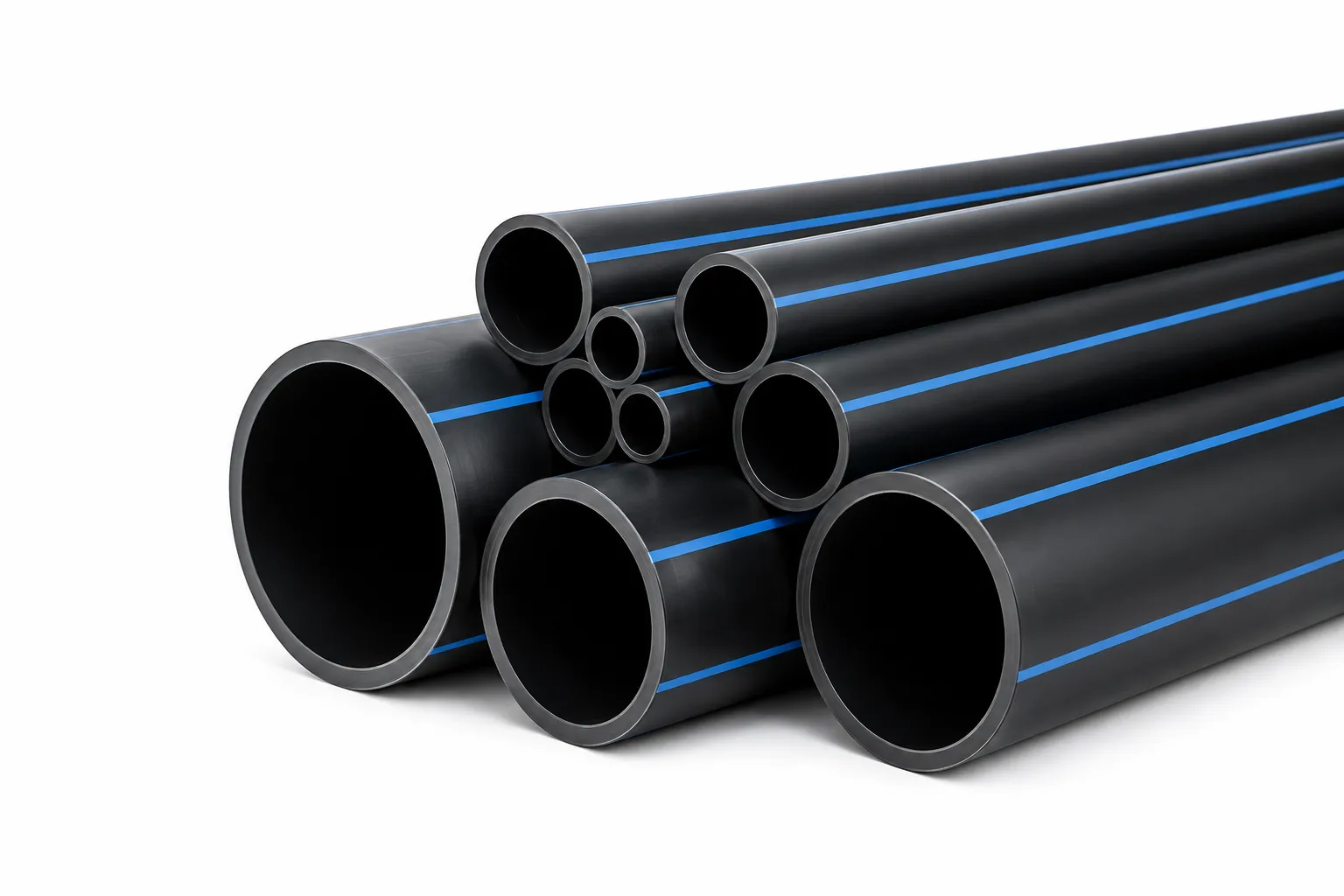
- Co-extruded Blue Stripes: Required on black pipes for potable water distribution (minimum 3 longitudinal stripes spaced evenly around the circumference).
- Traceability: Batch number, extrusion line, and manufacturing date are marked every 1 metre to allow complete batch traceability back to raw polymer silos.
- Verification: Government project inspection agencies (CIPET, RITES, SGS, WAPCOS) verify the BIS CM/L licence against the Bureau of Indian Standards online portal before issuing inspection clearance certificates (MDCC).
6. Why Engineers and Tender Bidders Choose TARKO
At our MIDC Hingna manufacturing plant in Nagpur, Sakhi Industries (TARKO) operates state-of-the-art extrusion lines with continuous ultrasonic wall-thickness monitors and gravimetric dosing. Because we maintain our own in-house NABL-aligned testing laboratory equipped per Annex B with hydro-testing pressure rigs, combustion furnaces, and digital MFR apparatus, every single batch leaves the factory with an authentic Manufacturer's Test Certificate (MTC).
Whether you are engineering a multi-village rural piped water supply scheme under Jal Jeevan Mission, high-head agricultural lift irrigation, or industrial effluent transfer, TARKO delivers factory-direct pricing, full tender documentation, and certified quality from DN 20mm up to DN 630mm.
Frequently Asked Questions
What is IS 4984:2016?
IS 4984:2016 is the mandatory Indian Standard (Fifth Revision) published by the Bureau of Indian Standards (BIS) specifying requirements for polyethylene (PE) pipes for the conveyance of water for human consumption, including raw water before treatment, and water for general purposes, at operating pressures up to 2.0 MPa (20 bar).
Is IS 4984:2016 mandatory for Jal Jeevan Mission (JJM) and PMKSY tenders?
Yes. All government water supply infrastructure projects across India, including Jal Jeevan Mission (JJM) and Pradhan Mantri Krishi Sinchayee Yojana (PMKSY), strictly require pipes conforming to IS 4984:2016 bearing the valid ISI standard mark and an active BIS CM/L licence number.
Does IS 4984:2016 permit the use of recycled or reprocessed plastic?
No. Clause 5.5 (as revised by Amendment 2) allows only up to 5% of the manufacturer's own clean rework material from its own production; recycled plastic and rework from outside sources are not permitted, as it causes premature brittle failure under hydrostatic creep stress.
What is the standard marking syntax on IS 4984:2016 pipes?
As per Annex D of the BIS Product Manual, every pipe must be marked at intervals not exceeding 1 metre with: Standard Mark (ISI mark), CM/L licence number, Manufacturer's name or trademark (TARKO), Material Designation (e.g. PE100), Pressure Rating (e.g. PN 10), Nominal Outside Diameter (e.g. DN 110), Standard Dimension Ratio (e.g. SDR 11), Batch Number, and Date of Manufacture.
What hydrostatic pressure tests are mandatory under BIS Scheme-I Table 1?
The BIS Product Manual mandates internal pressure creep rupture testing at 80°C for 48 hours for every production control unit (up to 48 hours continuous run). In addition, type tests include 27°C for 100 hours, 80°C for 165 hours, and 80°C for 1,000 hours to guarantee 50+ years of continuous service life.
Tools & Related Resources
Confused by a term? Look it up
FREE TOOLGet a PN & SDR recommendation
CHART & REFERENCEHDPE Pipe SDR Chart — Complete Reference for IS 4984:2016
CHART & REFERENCEHDPE Pipe PN Pressure Rating Chart — IS 4984:2016
TECHNICAL GUIDEPE63 vs PE80 vs PE100: Complete Material Grade Comparison
TECHNICAL GUIDEWhat is HDPE? Material, Pipe Grades, Standards & Uses
Need Help Choosing the Right Pipe?
Our team at TARKO will help you select the correct size, SDR and pressure rating for your project.