
TARKO — Pumps | Pipes | Cables & Wires
    BIS / ISI CERTIFIED · DIRECT FACTORY PRICING

    HDPE PLB Duct Pipes

    HDPE PLB duct pipe (Permanently Lubricated Bore) for underground optical fibre cable. Dual-layer co-extruded construction with a silicone-lubricated inner bore — coefficient of friction ≤ 0.06 — that lets fibre be blown over 1,000+ metres. Manufactured in Nagpur from virgin polyethylene conforming to IS 7328:2020, in standard PLB sizes from 25/20mm to 63/51mm.
    25–63mm
    Size Range
    ≤ 0.06
    Friction Coeff.
    1000m
    Coil Length
    Dual Layer
    Silicore Bore
    HDPE PLB Duct Pipes
    BIS / ISI Marked
    Virgin PE Material

    HDPE PLB Duct Pipes — Product Range & Catalog

    Filter by Size / Spec:
    PLB Duct Pipe (Silicore)Sizes Available
    Click to Preview

    PLB Duct Pipe (Silicore)

    Dual-layer co-extruded HDPE duct with permanently lubricated bore, supplied in 200m / 500m / 1000m coils.

    25/20mm32/26mm40/33mm50/42mm+1 more
    IS 4984 / ISO 4427

    HDPE PLB Duct Pipes — Features & Benefits

    Permanently Lubricated Bore

    Silicone lubricant co-extruded into the inner wall — bonded, not coated, so it never wears off

    Coefficient of Friction ≤ 0.06

    Versus 0.15–0.25 for plain HDPE conduit — the difference between blowing and pulling cable

    Blow Fibre 1,000m+

    Continuous runs at up to 100 m/min without intermediate access pits

    Dual-Layer Construction

    Virgin HDPE outer sheath for crush and impact strength, silicore inner layer for low friction

    UV Stabilised Outer Sheath

    2.5 ± 0.5% carbon black in black compound for outdoor storage and exposed sections

    Air & Water Tight Joints

    Push-fit couplers hold blowing air pressure and keep groundwater out

    HDPE PLB Duct Pipes — Applications & Uses

    BharatNet & Rural Fibre

    5G Backhaul & Tower Fiberisation

    Railway Signalling (RDSO)

    Highway OFC (NHAI / MoRTH)

    Smart City Utility Corridors

    FTTH & Broadband Rollout

    Dimensions & Specifications Chart

    Outer diameter, wall thickness, SDR ratios, and weight metrics per Indian Standards.

    Virgin PE Material (IS 7328:2020)Standard PLB OD/ID SizesSilicore Co-Extruded Bore
    Size (OD/ID)Wall ThicknessInner DiameterCrush ResistanceApprox Weight
    25/20mm2.5 ± 0.2mm20mm250 kgf≈0.17 kg/m
    32/26mm3.0 ± 0.2mm26mm250 kgf≈0.26 kg/m
    40/33mm3.5 ± 0.2mm33mm450 kgf≈0.38 kg/m
    50/42mm4.0 ± 0.2mm42mm550 kgf≈0.55 kg/m
    63/51mm6.0 ± 0.5mm51mm800 kgf≈1.02 kg/m

    Duct Class & Friction Rating

    PLB duct is not a pressure pipe — it is classified by bore lubrication and coefficient of friction.

    PLB Duct (Silicore)SDR COF ≤ 0.06

    Co-extruded permanently lubricated bore for blowing optical fibre cable

    Why Choose TARKO HDPE PLB Duct Pipes?

    PLB stands for Permanently Lubricated Bore. TARKO manufactures HDPE PLB duct pipe at our Nagpur facility as a dual-layer co-extruded pipe: a virgin HDPE outer sheath that takes the crush and impact loads of burial, and an inner silicore layer with silicone lubricant locked into the polymer matrix during extrusion.

    Frequently Asked Questions

    PLB stands for Permanently Lubricated Bore. It is an HDPE duct pipe with a silicone-based lubricant layer co-extruded into the inner wall during manufacture — not applied as a coating. This permanently reduces friction so optical fibre cable can be blown through over long distances.
    They solve different problems. PLB duct is a smooth-wall, dual-layer pipe with a lubricated bore (coefficient of friction ≤ 0.06) designed for blowing optical fibre cable over 1,000+ metres. DWC (Double Wall Corrugated) pipe has a corrugated outer wall for crush strength and is used to protect power and telecom cables that are pulled, not blown. PLB is specified by TEC; DWC by IS 16025.
    PLB duct is designated by an OD/ID pair. Standard sizes are 25/20mm, 32/26mm, 40/33mm, 50/42mm and 63/51mm. The 40/33mm size is the most widely used for backbone optical fibre networks; 25/20mm is common for FTTH last-mile connections.
    Cable is installed in PLB duct by blowing it in with compressed air rather than pulling it. A coefficient of friction of 0.06 or lower — versus roughly 0.15–0.25 for plain HDPE conduit — is what allows blowing speeds up to 100 m/min and continuous runs beyond 1,000 metres without intermediate access pits. That directly reduces excavation, jointing and installation cost.
    For the product category as a whole, the finished duct is specified by the TEC (Telecommunication Engineering Centre) Generic Requirement, and railway signalling work additionally references RDSO/SPN/TC/45/2006. The polyethylene raw material is covered by IS 7328:2020. TARKO manufactures PLB duct to the standard OD/ID sizes and performance parameters used across the industry; if your tender requires a TEC-approved or RDSO-approved supplier, please confirm your certification requirement with us before ordering.
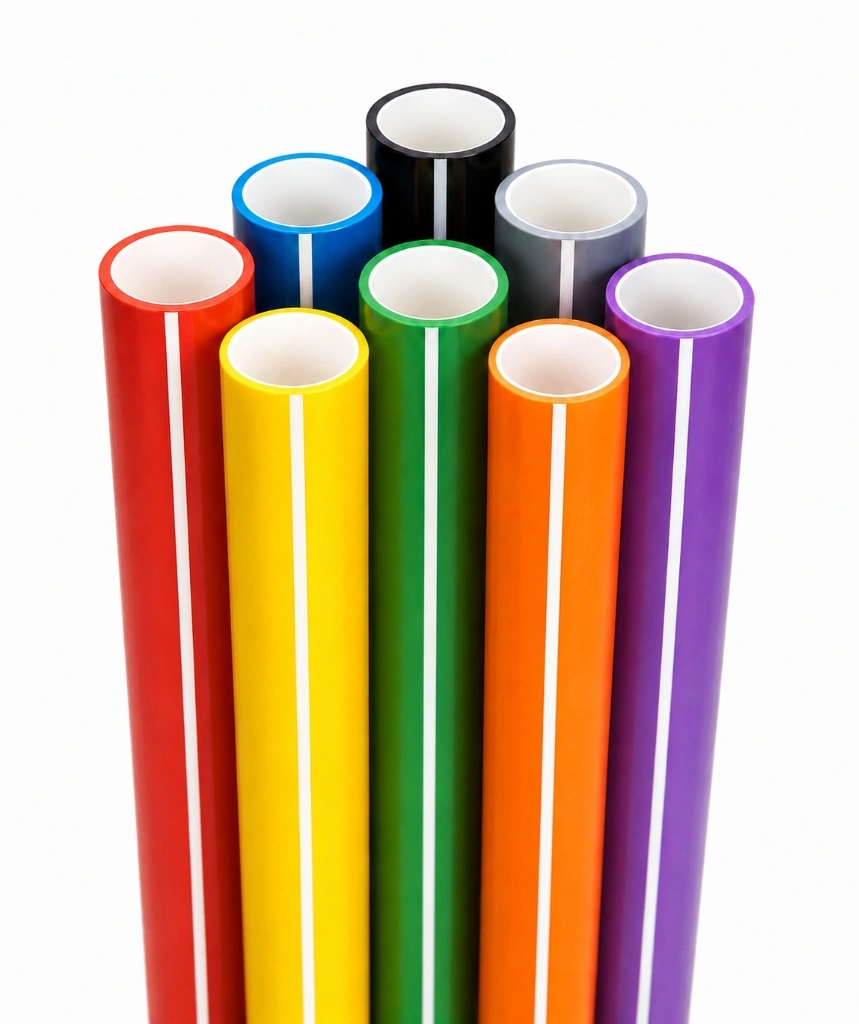
    Colour is used to identify separate networks or operators sharing the same trench — commonly Red, Green, Orange, Blue, Yellow, Grey, Brown and Black. There is no single mandatory national colour code; the scheme is normally fixed by the project or operator. Identification stripes along the duct can also be supplied to customer requirement.
    PLB duct is supplied in coils of 200, 500 or 1,000 metres, which keeps the number of joints low over long runs. Lengths are joined with push-fit plastic couplers that seal air-tight and water-tight — essential because the duct must hold air pressure during cable blowing. End plugs seal ducts before cable installation and cable sealing plugs seal them afterwards.
    PLB duct is the standard conduit for underground optical fibre in India — BharatNet gram panchayat connectivity, 5G backhaul and tower fiberisation, NHAI and MoRTH highway OFC, smart city utility corridors, railway signalling networks, and FTTH/broadband rollouts by private ISPs.

    Need Project Assistance or Bulk Quote?

    Speak directly with our technical sales engineering team in Nagpur.

    Related Products & Systems